01 November 2016

Film Noir and Noirvember!


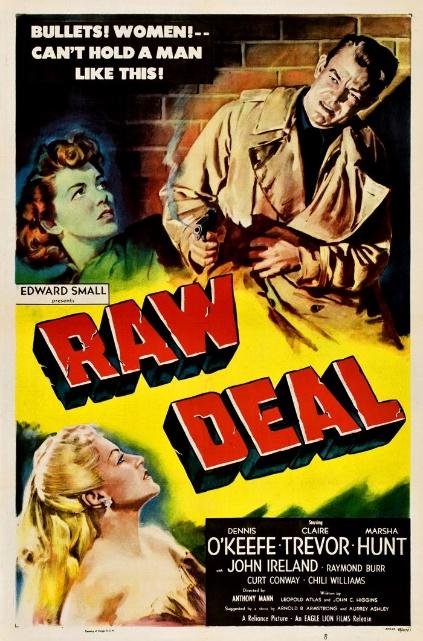
Though its often quoted as a genre, “film noir” (pronounced film nwar – yeh its one of those words that makes you self-conscious when saying it cause it never sounds right!) is more about style and mood rather than genre. “Film Noir” was a term given by the French as a response to some of the American films, essentially meaning “black film” due to its darker portrayal of characters and visual styles.   As the term Film Noir was not even thought of back when many of the films in question were made, it can be hard to define exactly what a Film Noir is.  In fact, many books by much smarter people than I have been written solely about Film Noir and what it is or isn’t, so I have no intention to try to replicate that, but instead give a simple overview to help you get a basic idea as to what it is (if you want a simple, visual cheat sheet check out the awesome guide at the British Film Institute website here http://www.bfi.org.uk/news-opinion/news-bfi/features/infographic-what-makes-film-noir or you can read on for my quick thoughts).

Generally speaking, they were made primarily during the 40’s and 50’s and usually were a combination of (but not limited to) the following:
  • About or involving a crime of some sort (eg. Theft of money or something of value)
  • Contained low-key lighting (low light, high contrast) with plenty of shadows
  • Creative camera angles including in some cases extreme close-ups
  • The leading/main character often has an unhappy ending
  • The presence of a bad guy
  • Often a good and bad females involved
  • Sharp and witty dialogue
  • More smoking than a steam train
As stated above the list is not in any way comprehensive and can have many variations.  For example, the main character could be a cop (The Prowler, The Big Heat), a boxer (The Setup, Champion), a crook (The Killing, This Gun for Hire), Insurance salesman (Double Indemnity) or even an innocent citizen (D.O.A.).  There are times where the ending is “happy” but I suspect that it was forced on the movie makers via the Hays Code (a type of code of conduct for movies from the late 30’s up until the 60’s).  Also the plot can sometimes be quite involving even to the point of confusion (The Big Sleep) that forces multiple viewings to try to figure out what is happening to who.  And there can often be double crosses between.
Interestingly, as the Nazi’s came to power in Germany (prior to WW2) various directors (some being Fritz Lang, Robert Siodmark and Billy Wilder who were very highly respected), cinematographers and actors/actresses fled the Nazi regime and landed up in Hollywood and they also brought along their European influence (especially German) which also assisted in defining the style as the years went on.
These were often classed as “B” movies as opposed to the “A” or Premium movies which had higher budgets and more scrutiny from the big bosses in the film companies involved.  So being a “B” movie in some ways had advantages cause as long as you kept to budget and within specified time frames you had a bit more freedom and as costs in lighting also had to be reduced it assisted in giving the film a visually darker look that is often filled with shadows.  As the demand for “B” movies was greater (making a quick buck) the reigns were often passed to on to these foreign directors who fled some of the war torn countries of WW2 and therefore the blend of European and American cinema began.  
It is generally agreed that the first Film Noir was “Stranger on the Third Floor” which was a 64-minute film which had a mix of international cast (eg. Peter Lorre) and crew.  Many also consider Orson Welles’ “Touch of Evil” from 1958 as the last real Noir.  There are modern noir’s, often termed neo-noir, where a film maker tries to adopt some of the styles of the 40’s and 50’s Noir but with modern themes and ideas and in colour, though there is the odd exception such as The Man Who Wasn’t There which was shown in Black and White which perfectly suits the film (a small comparison can be seen here http://www.dvdbeaver.com/FILM/dvdcompare/manwho.htm).
A very small list of Film Noir examples would be In a Lonely Place, The Killers, Detour, Ace in the Hole, The Blue Dahlia, Murder my Sweet, The Big Heat, Double Indemnity, Gun Crazy and Kiss Me Deadly.  Again a small list of Neo-noir examples would be Payback, House of Bamboo, Drive, Driver, Chinatown, L.A. Confidential, Fargo, Blade Runner, and The Usual Suspects.
As Film Noir is a style of film I really enjoy, you will no doubt see more reviews of these movies but I will usually try not to post too many in a row so there will some variety.  However, as this is November I thought it would be good to mainly concentrate on Noir and therefore call it Noirvember!  So in the coming weeks I will mainly be pumping out a combination of Film Noir and Neo Noir along with my promised review of a recently released 50’s sci-fi in 3D.  So stay tuned!

30 October 2016

The Beast from 20,000 Fathoms (1953)


George Ritchie: [referring to the A-bomb test] You know every time one of those things goes off, I feel as if I was helping to write the first chapter of a new Genesis.
Professor Tom Nesbitt: Let's hope we don't find ourselves writing the last chapter of the old one.
One morning many years ago as a little boy, I woke up in the wee hours and decided to watch a movie.  At the time I had no idea of the name of the movie but as I sat there and watched in awe (I was well under 10), one part of this movie was imprinted on my mind.  A large lizard type creature was tearing apart a rollercoaster as men tried to bring a stop to the destruction it brought.  Jump forward some…well a lot of years, I finally found out what that movie was called, and here today we have that movie in review.
There has been a whole assortment of monster movies over the decades which all revolve around either a larger than normal creature of some kind or at least a very destructive one, but either way they wreak havoc on towns, cities and of course people.  We have giant/killer octopus, spiders, squid, frogs, rats, bees, gorillas, more spiders, crabs, lizards, fish of various kinds (need I mention sharks separately?), Crocodiles/Alligators (gotta love Lake Placid!), snakes, ants, cockroaches, dinosaurs and O boy does the list go on and on and on.   Needless to say, these type of movies struck a chord in us and, for some reason, became popular.  We like to have dominion over the beasts/birds/fish of the earth and if they try to fight back (eg. The Aussie film Long Weekend) we fight all the more to rule them.  Well that’s the way we like it anyway.  As with all things, they need to start somewhere and when it comes to giant monster movies it all started with a silent film called The Lost World in 1925, then we had that the 1933 King Kong (reviewed here …………….), then a Japanese version of King Kong came out in 1949 called Wasei Kingu Kongu and finally in 1953 we have our film in review being The Beast from 20,000 Fathoms.  It is the first movie where a beast was revealed from the effects of a nuclear explosion, so its landmark in that regard.
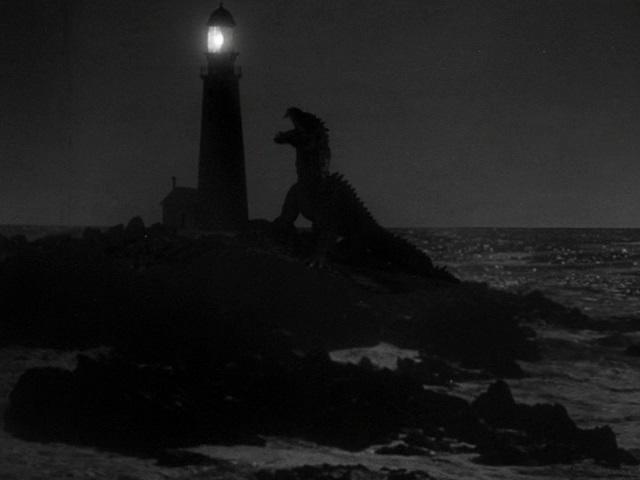
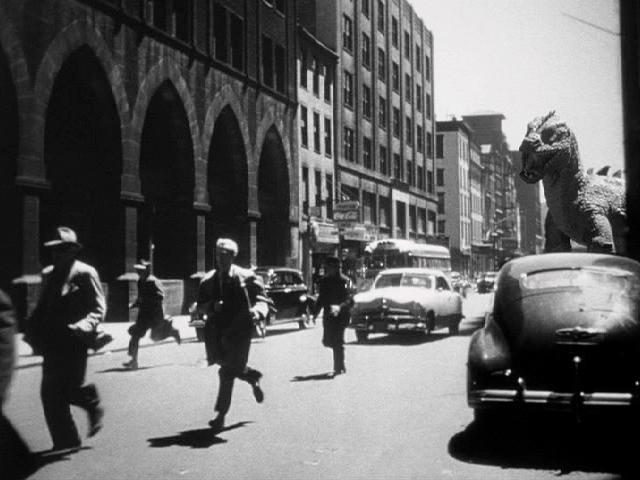
In the far northern Arctic circle, a nuclear bomb test is conducted which awakens/thaws out a Rhedosaurus from his icy slumber.  One survivor Prof. Tom Nesbitt (Paul Christian aka Paul Hubschmid) see’s the creature briefly before it disappears but gets ridiculed by his peers and doctors as having some kind of hallucination and is essentially palmed off.  But when the monster starts making some sporadic appearances from the Artic down along the North American coast, the curiosity of palaeontologist Thurgood Elson (Cecil Kellaway) and his assistant Lee Hunter (Paula Raymond) is captured and when Tom points out what the beast looked like from various drawings they had, they start making serious queries.  Eventually the beast finds its way to New York and they do all they can to bring a stop to the beast and the trail of destruction it has left behind.
Whilst being a new thing back then in 1953, the idea of a giant monster terrorising a town or city has been used and abused over the years so finding an original story is pretty hard and this is no exception.  The creature is brought to the screen via, you guessed it, stop animation by the then young Ray Harryhausen who would go on to bigger and bolder projects over the coming decade and a half.  A few of Harrryhausen’s later films, namely It Came From Beneath the Sea, 20 Million Miles to Earth and Earth vs the Flying Saucers, have been colourised recently using new techniques which has breathed new life into them however this one missed out on getting the treatment but that does not detract me one but from watching it.  To me, black and white is still a string format whether that be in still photography or video.
It is an impressive film and one that brought back fond memories of that night so long ago (gee that makes me sound old) when I was watching it for the first time in the wee hours of the morning.  It has a realistic feel to it without being over done or excessive and there is that sense of mystery in how the main characters came to discover its existence.  I wouldn't call it the best movie of this genre that’s for sure, but it is a classic and it will no doubt be watch again.  
The Bluray used for the review was imported from the US and is region free.  Considering the age of the source film, the image, in its 1.37:1 aspect ratio, is in great shape with good sharpness and contrast and is no doubt as good or even better than its original screening at the cinema/drive-in.  The audio comes to us via DTS HD Master Audio in the original mono format and sounds good for the movie.  We have also been given the following extras:
  • The Rhedosaurus and the Rollercoaster: Making the Beast (documentary)
  • Harryhausen & Bradbury: An unfathomable Friendship Armatures (documentary)
  • Theatrical Trailer
Overall this is a movie I enjoyed watching and is a solid movie in itself, but I wouldn’t say it is everyone’s cup of tea.  It comes recommended for those interested in old 50’s monster movies or Ray Harryhausen’s animation work, but apart from that you could find better.  It is not Harryhausen’s best work but it is some of his early stuff and it still very well done especially as the beast goes between the city buildings having the shadows cast upon it, which would have taken quite a lot of effort.  
Movie
Image
Disc     

24 October 2016

Road Games (1981)


Patrick 'Pat' Quid: I know you're looking for a little adventure.
Pamela 'Hitch' Rushworth: I could go to Disneyland for a little adventure. What I'm looking for is a little excitement.
I will start out and say that this is not to be confused or compared with the 2015 film of the same name.  Ok that’s out of the way.
Hitchcock, one of the most well-known directors, influenced quite a few people not just overseas, but also here in Australia.  The Australian Director Richard Franklin and writer Everett De Roche got inspired to bring the film in review to life after reading the script for Hitchcock’s 1954 hit Rear Window, but instead of being set in a block of units, this one would be from a truckers point of view, from a vehicle and it is quite an effective angle.  Sure it’s not as good as Rear Window, but it is a solid Aussie film that has a Hitchcock feel to it.
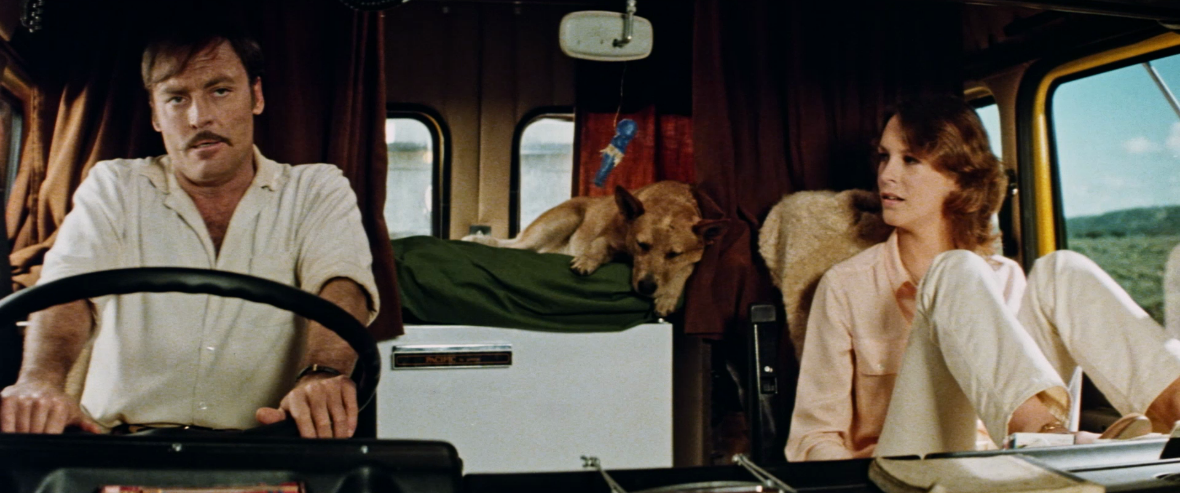
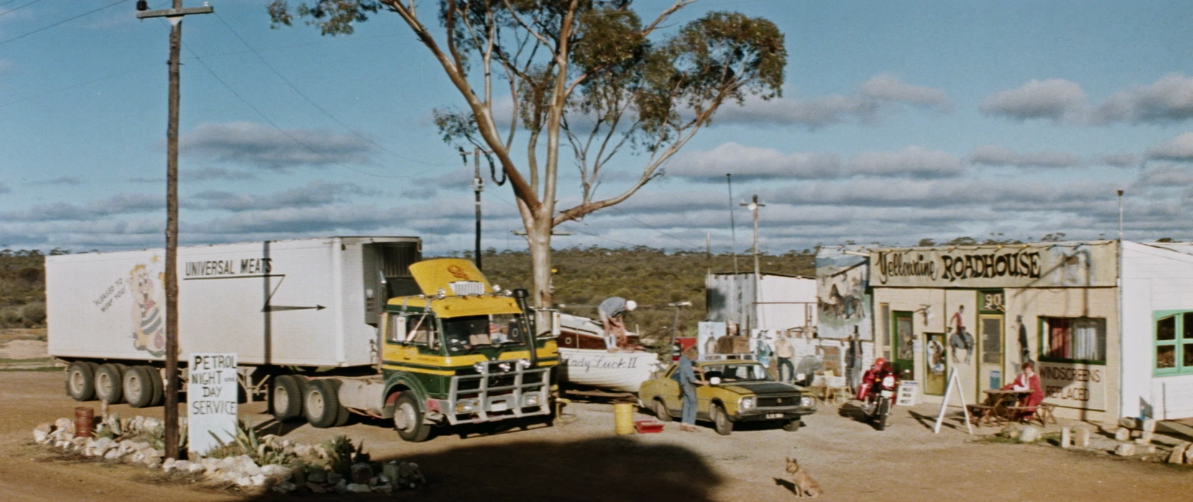
The film takes place between Melbourne and Perth along the desolate sections of the Nullabor Plain which is a perfect setting for this type of mystery thriller film as there are no large populated areas along it which just enforces the idea of isolation.  Pat Quid (Stacy Keech) is a truck driver currently in Melbourne who is required to deliver a load of butchered pigs to Perth.  As the drive is long he keeps himself awake and amused by maintaining a conversation with his dog and himself, often in a theatrical way.  During this time there is a killer who preys upon hitchhikers who just so happens to be on a similar route to Quid.  Quid picks up hitchhiker Pamela “Hitch” Rushworth (Jamie Lee Curtis) and together they start playing with the idea of catching this murderer seeing he appears to be on the same route, but as with all games there is a winner and loser.  
I really enjoyed the film and there were moments where there was some nail biting suspense, in a typical Hitchcock manner.  You don’t always see things which supposed to provide suspense but rather it’s in the hearing, lighting and acting that provide the suspense as opposed to seeing someone killed in front of you.  There isn’t really any gore and we have minimal swearing and one scene of concealed nudity (you don’t see anything as the actress is behind a guitar) which is a nice change from other Aussie films of this era where, sadly, it almost seemed like a mandatory addition to a film.  There are some good driving stunts in the film as well which do not overpower the believable story.
To get some publicity, it was decided to bring in American actors as the two leads which was not completely unusual for the time and no doubt contributes to it being the most expensive Australian film to be made at the time ($1.8 million).  It was filmed literally along the Nullabor so as the movie progresses so does the filming locations, though from what I understand the final scene was filmed in Melbourne, not Perth.  Stacy Keech had to learn how to drive a 16 speed truck in order to pull off a convincing job and he does quite well in the film.  Jamie Lee Curtis starred in several horror films prior to this so there was the idea that Road Games was more of a slasher film even though it wasn’t so it didn’t do too well at the American box office most likely because of that.  It also didn’t do too good in Australia at the time but has since grown in popularity and holds up quite well to this day both in terms of filmmaking and acting.  
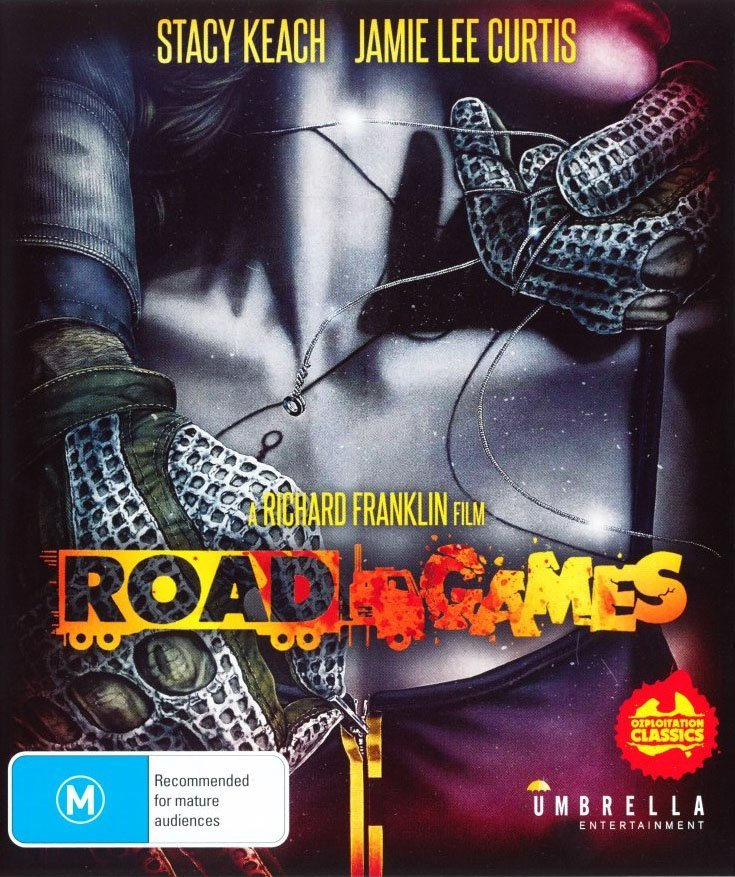
Though I own the DVD version of the film, I jumped for the Bluray especially upon hearing it was going to be given the 4k restoration treatment.  Is there a difference between the old Umbrella DVD release and the Bluray?  Yes, a massive difference.
This is from the DVD…
And the Bluray…
Not just is the new scan giving us more of the image both top and bottom but more information is revealed on both the left and right.  The increase in resolution, contrast and colour is also striking and is only amplified with today’s larger screens. The image is a bit darker than the DVD but that also suits the modern TV better with its ability to handle greater dynamic range.  The image is shown in the 2.35:1 aspect ratio and as indicated above, is superior to the old DVD edition which is now out of print.  The new DVD will also be somewhat better than the old DVD but naturally not as good as the Bluray.  What is a little disappointing is the choice of audio which only comes to us in two flavours but both in a lossy format and not the uncompressed format that is standard with Bluray.  We have a new Dolby Digital 5.1 (448kbs) and the original mono (224kbs) soundtrack to choose from.  Perhaps they thought it would not give too much improvement, however leaving that choice up to the consumer would have been a better move.  Nevertheless, the audio comes across quite good.
The Bluray also contains the following wealth of extras:
  • Audio Commentary with Producer/Director Richard Franklin
  • Kangaroo Hitchcock: The Making of “Road Games” featurette
  • Uncut Not Quite Hollywood interviews with Jamie Lee Curtis, Stacy Keech, Grant Page, Richard Franklin, Everett De Roche, Vincent Monton and Tom Burstall
  • Never before seen 1980 lecture on the Making of Road Games from Richard Franklin, Co-Producer Barbi Taylor & Composer Brian May
  • 1981 Interview with Richard Franklin
  • 2001 Audio Interview with Richard Franklin
  • Exclusive New Audio Interview with Stacy Keech
  • Exclusive New Audio Interview with Stunt Co-ordinator & Actor Grant Page
  • 4K Scan & Restoration featurette by Roar Digital & Interview with Cinematographer Vincent Monton
  • Exclusive Essay by Fangoria writer Lee Gambin
  • Gallery of Stills, Production Shots, Storyboards, Newspaper Reviews, Promotional & Artwork Materials
  • HD Theatrical Trailer


Overall, Road Games is a classic Australian thriller with a Hitchcock flavour that really deserves more attention than it has received.  It stands up well against today’s movies despite the limited budget (comparably) and camera equipment used.  It is acted well and has some great moments of suspense and we also have the great Aussie outback as a setting.  If you like a good thriller or enjoy Hitchcock films, then this comes highly recommended.  Check it out!


Movie     
Image
Disc